



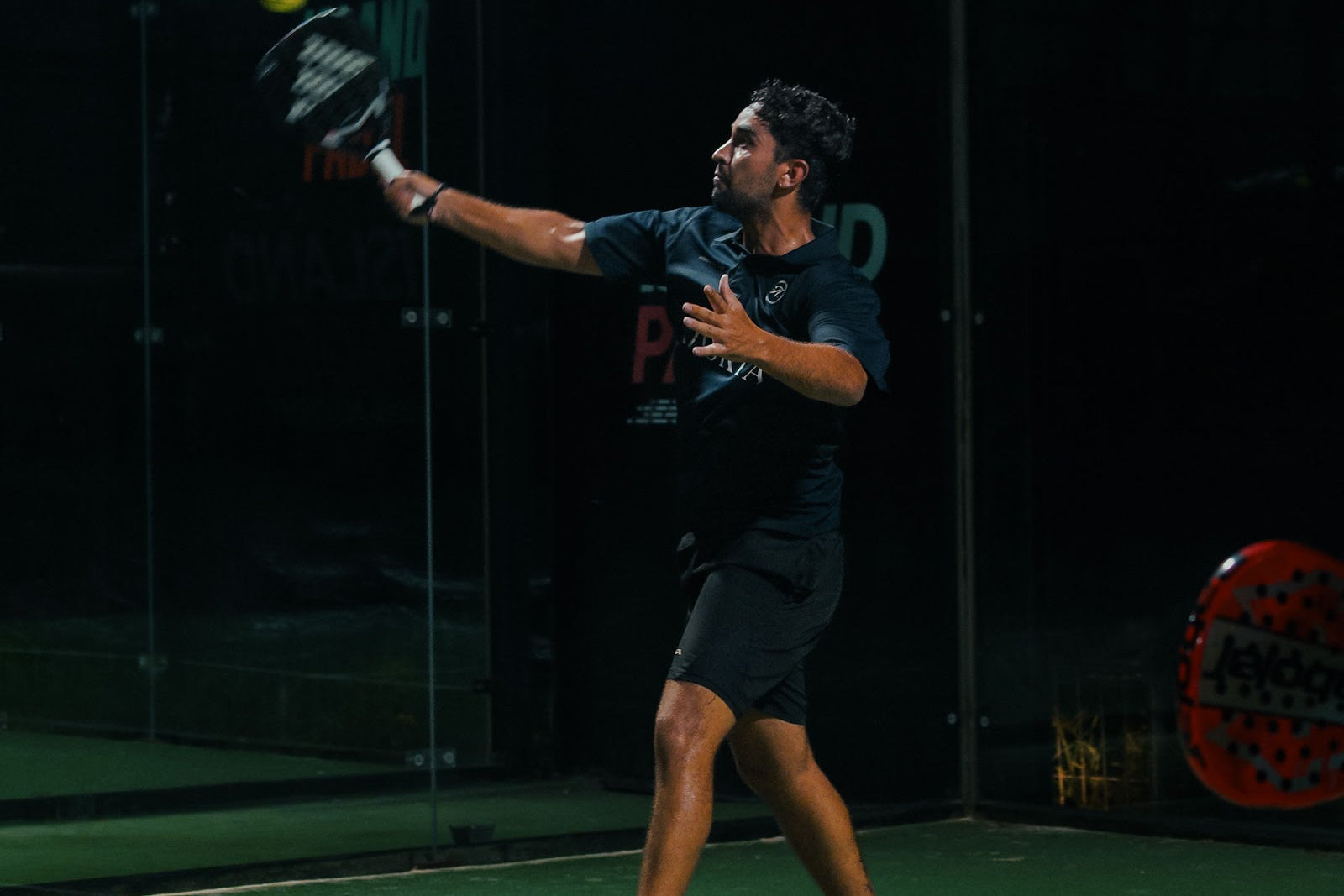
Padel is the easiest racquet sport to start and one of the hardest to put down. If you have never held the racquet, this guide to padel for beginners covers the rules, the scoring, the kit, and how long it takes before a real game breaks out. The short answer: most people are rallying within an hour, on a court the size of a small swimming pool, glass walls and all.
The short version: Padel is a doubles game played on an enclosed court with glass walls that stay in play. The serve is underhand, scoring follows tennis (15, 30, 40, game), and a beginner can hold a rally in the first session. Comfortable shoes, a borrowed racquet, and three friends are all you need to begin.
What is padel, in one minute?
Padel is a doubles racquet sport played on an enclosed court roughly 20 metres by 10 metres, with walls of glass and mesh that are part of play. You hit a low-pressure ball with a solid, stringless racquet, and the ball can rebound off your own back and side walls before you return it. That single rule, the wall in play, is what makes the game feel less like tennis and more like chess with a heart rate.
It is the fastest-growing racquet sport in the world. The International Padel Federation counted more than 35 million players across 150 countries by the end of 2025, with the global court total passing 77,000. Spain and Italy lead, Europe holds roughly two-thirds of all courts, and the Bukit has quietly joined the map. The reason it travels so well is simple. It is sociable, it is gentle on the body, and almost anyone can rally on day one.

How do you play padel? The rules, simply
Padel is always played two against two. You win a point when the ball bounces twice on the opponents' side, when they hit it out or into the mesh on their own side, or when it strikes a wall before bouncing on their floor. The serve is underhand, hit below the waist, and must bounce once in your box before you send it diagonally into theirs. You get two serves, as in tennis. The walls do the rest of the talking.
Scoring, the part you already half-know
Scoring is borrowed straight from tennis. Points run 15, 30, 40, then game. Level at 40-40 is deuce, and a side needs two points clear to take the game. Six games wins a set, by a margin of two, and a tie-break is played at 6-6. Matches are best of three sets. If you have ever watched Wimbledon with one eye, you already know the count.
The walls, the one new idea
Here is the only genuinely new rule for a beginner. After the ball bounces once on your floor, it can rebound off your own glass and you can still play it. What you cannot do is let it hit your wall before it has bounced on the floor. Learning to stand off the back glass and let the ball come back to you, rather than chasing it, is the move that separates week one from week three.
Padel and tennis, side by side
| Padel | Tennis | |
|---|---|---|
| Format | Doubles only | Singles or doubles |
| Court | 20 x 10 m, enclosed by glass | Larger, open, no walls |
| Serve | Underhand, below the waist | Overhead |
| Walls | In play after the bounce | None |
| Racquet | Solid, stringless, perforated | Strung |
| Learning curve | Rally on day one | Weeks to a steady rally |
Five things every beginner should know
The fundamentals that get a new player rallying and keep them safe on a hot court. None of these takes talent, only attention.
- Let the ball bounce off the back glass. Resist the instinct to volley everything. Step back, stay balanced on the balls of your feet, and let the wall feed the ball back to you. Patience wins more points than power at the start.
- Hold the net as a pair. The team standing together a couple of steps from the net controls the point. Move up together, fall back together. Padel is a game of two, played as one.
- Softer is smarter. Beginners swing too hard. Control beats pace on a court this size, where the walls give the ball back. Place it, do not pummel it.
- Use the lob. A high ball over the net players is the most useful shot you will learn early, pushing opponents off the net and buying you time to recover position.
- Communicate. Call the middle ball, name who takes it. Half of all beginner points are lost to two players watching each other instead of the ball.

What do you need to start playing padel?
Almost nothing. A pair of court shoes, a racquet you can borrow for the first few sessions, and three other people. Clubs lend racquets and sell balls, so there is no reason to buy anything before you know you love the game. When you are ready to own your kit, three things matter.
The racquet. Start with a round head, a soft core, and a weight around 360 to 370 grams. The round shape gives a larger sweet spot and forgives the mishits every beginner makes. Leave the teardrop and diamond shapes, the ones the professionals swing, for later. There is more in our guide to choosing your first padel racket.
The shoes. This is where to spend first. Look for a herringbone sole, the deep zig-zag tread built for the lateral sliding that padel demands. Run a hand over the outsole. It should feel rough and rigid, the grip that keeps you upright when you change direction at speed. Running shoes will not do, and on a warm court they are a quick way to turn an ankle.
The ball. Padel balls look like tennis balls and behave differently, with slightly lower pressure. Any padel-specific ball is fine to learn with. You do not need to think about brands yet.
How long until you can actually play?
One session to rally, a handful of lessons to play a proper game. Padel's low barrier is the whole point. The underhand serve removes the single hardest thing in tennis, and the walls give you a second chance at almost every ball. Most beginners are keeping a rally going within the first hour, which is why the game spreads through friend groups the way it does.
Two or three sessions with a coach will sort out your grip, your court position, and the back-glass timing that is hard to find alone. After that, the game opens up quickly, and the pleasure shifts from simply returning the ball to placing it where your opponents are not. The ceiling is high. The floor is wonderfully low.

Where to learn padel in Uluwatu
Uluwatu has courts now, and the game has found its natural home on the Bukit. At the Azoria Padel Club, the courts sit on the clifftop, west-facing, and the day is built around the rhythm of the game: a seven-minute warm-up, a long match, the longer drink after. Beginners are not an afterthought here. The Azoria Padel Academy runs structured coaching for first-timers, the kind of two or three sessions that take you from holding the racquet to holding the net.
If you are arriving from a morning in the water or a session in the Azoria Fitness Club, padel slots neatly into the afternoon. And the part nobody tells you about the sport, the table afterwards, is taken seriously at Azoria Dining, where the match tends to carry on in conversation long after the last point. For the wider picture of the game on the cliff, read our clifftop guide to padel in Uluwatu.
Frequently asked questions
Is padel easy for beginners?
Yes. Padel is one of the most beginner-friendly racquet sports. The underhand serve and the enclosed walls mean most people can rally in their first hour, with no prior tennis experience needed.
Can you play padel without a partner?
Padel is doubles only, so you need four players in total. Clubs run social sessions, mixers, and beginner clinics that pair you up, so arriving solo is no obstacle to a game.
Do I need my own racquet to start?
No. Most clubs lend racquets and sell balls, so you can play several times before buying anything. When you do buy, start with a round-headed racquet around 360 to 370 grams and proper padel shoes with a herringbone sole.
What is the difference between padel and tennis?
Padel is played on a smaller enclosed court with glass walls in play, uses an underhand serve and a solid stringless racquet, and is doubles only. The scoring is the same. Padel is easier to start and built around longer, more social rallies.
Is padel a good workout?
It is. A padel match is steady, social cardio with plenty of lateral movement, less pounding than tennis and easier on the knees, which is part of why it suits a wide range of ages.
Borrow a racquet. Find three others. Court three opens at six, and the first rally is closer than you think.
Further reading
- International Padel Federation, official Rules of Padel. The governing body's full rulebook, for when you want the letter of the law.
- FIP World Padel Report 2025. The numbers behind the boom: players, courts, and countries.
- LTA Padel, how to get started. A clear, current primer on rules and first steps from Britain's tennis and padel body.
Bagikan:
Padel in Uluwatu: A Clifftop Guide to the Game