



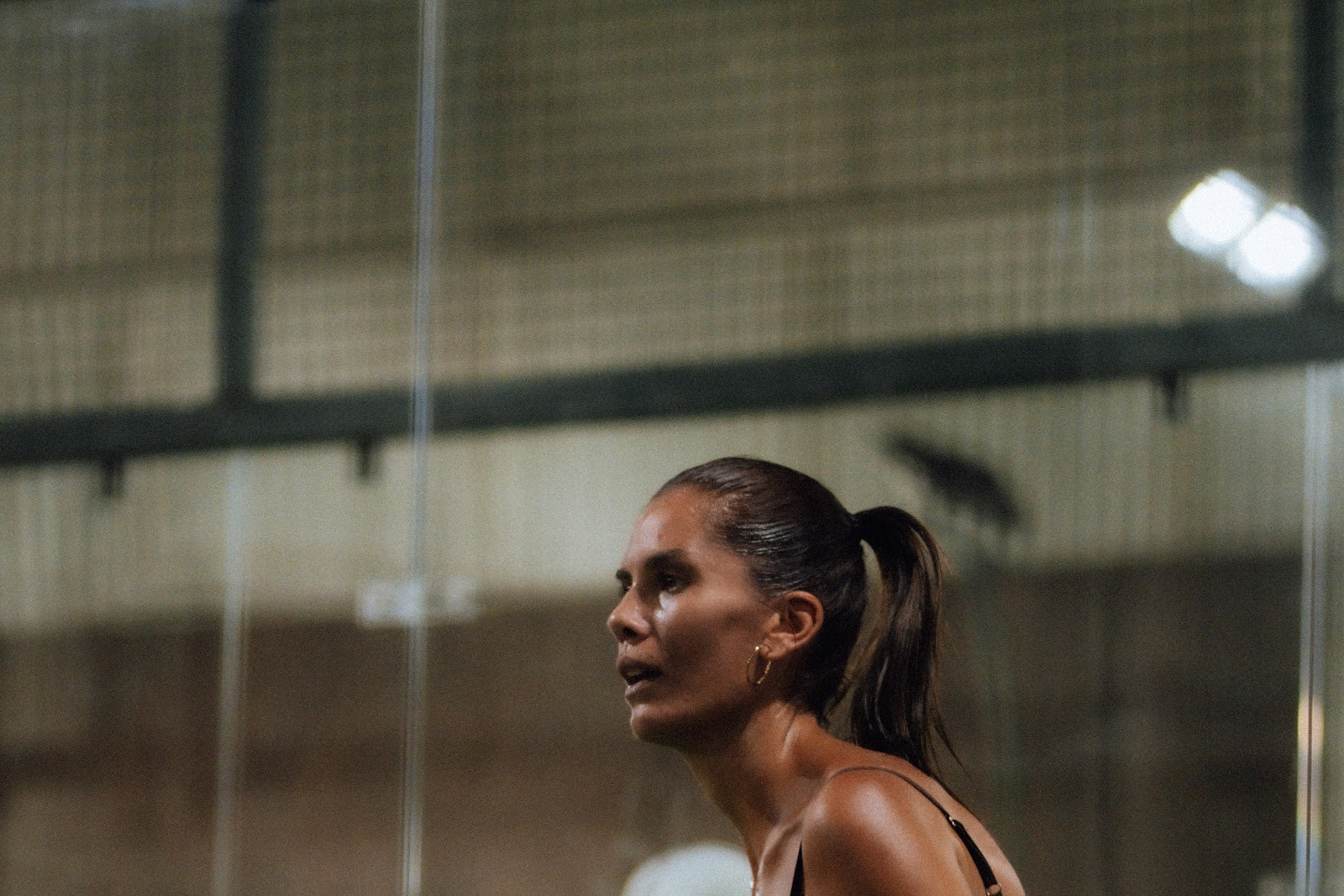
If you have held a tennis racket, you already know half of padel. The scoring is the same. The instinct to get the ball back is the same. What changes is everything around it: a court a third of the size, glass walls that keep the ball alive, a short solid bat instead of a strung one, and a serve you bowl underarm rather than throw overhead. The difference between padel vs tennis is not difficulty. It is design. Padel was built to be easier to start and slower to leave.
The short version: Padel is played in doubles on an enclosed court roughly a third the size of a tennis court, with walls that are part of the play, an underarm serve, and a short stringless racket. The scoring is identical to tennis. Padel is far easier to learn, harder to master, and built around the rally rather than the ace.
What is the difference between padel and tennis?
Padel and tennis share a scoring system and a net, and almost nothing else. Padel is played as doubles inside a glass-and-mesh box, the walls are in play like squash, the serve is underarm, and the racket is a short solid bat with no strings. Tennis is faster, longer, more physical, and rewards power and reach. Padel rewards angles, patience, and the player who reads the rebound.
Padel started in a garden. In 1969, Enrique Corcuera built a small walled court at his home in Acapulco because there was no room for a full tennis court, then closed it in with walls to stop the ball escaping. The sport travelled to Spain through the Marbella Club and to Argentina soon after, and stayed largely a Hispanic club sport for decades. It is no longer a secret. The International Padel Federation now counts more than 35 million players and over 77,000 courts across roughly 150 countries, which makes it the fastest-growing racquet sport in the world. Bali has been part of that wave, first loudly in Canggu, now on the Bukit.
Padel vs tennis at a glance
The quickest way to see the gap is side by side. Same scoring, almost nothing else in common.
| Padel | Tennis | |
|---|---|---|
| Court size | 20m x 10m, fully enclosed | 23.77m x 10.97m doubles, open |
| Walls | In play (glass and mesh) | None |
| Format | Almost always doubles | Singles or doubles |
| Serve | Underarm, below the waist, after a bounce | Overhead |
| Racket | Short, solid, no strings (~45cm) | Long, strung (~68cm) |
| Ball | Slightly lower pressure | Standard pressurised |
| Scoring | 15, 30, 40, deuce, best of 3 | 15, 30, 40, deuce, best of 3 |
| Learning curve | Quick to rally in one session | Weeks to sustain a rally |
Is padel easier than tennis?
Yes, padel is easier to learn than tennis, and that is the whole point. Most people can hold a real rally within their first session, where tennis can take weeks before two beginners can keep the ball in play. Three things make the difference: the court is smaller so there is less ground to cover, the walls give you a second chance at a ball that would be a lost point in tennis, and the short solid racket is far more forgiving than a long strung frame with a small sweet spot.

The underarm serve removes the single hardest skill in tennis for a beginner. There is no toss to time, no overhead motion to groove. You drop the ball and strike it below the waist.
Easy to start is not the same as easy to win. At the top level padel is a chess match of lobs, walls and positioning, and the better pair almost always beats the bigger hitters. Power matters less than placement. This is why padel flatters the patient player and why a fifty-year-old who reads the game can take a set off someone half their age. Tennis rarely allows that.
How the walls change the game
In tennis a ball past you is gone. In padel it is an invitation. After the ball bounces on your side of the court it can carry into the back glass and come off at a readable angle, and you are expected to let it travel, set your feet, and play it off the wall. Good players use the walls on purpose, defending off the back glass and attacking the rebound. It is the part that feels strange for an hour and obvious by the end of the afternoon. It also keeps rallies long, which is most of the social charm: the point does not die quickly, so neither does the conversation around it.

Padel vs tennis on the body
Padel is lower impact than tennis. The court is short, so there is less sprinting and less of the hard braking and shoulder load that overhead serving brings. The exchanges are quicker and more lateral, more stop-start than long-distance. That makes padel kinder to knees, backs and shoulders, and it is part of why it draws a wide age range onto the same court. It is genuine exercise, an hour of doubles is a real sweat in the Bukit heat, but it asks less of the joints than a tennis singles match in the same conditions. Recovery still earns its place after a long set, which on the Bukit means shade, water, and something cold before the next round. More on that in Azoria Wellness.
Should a tennis player switch to padel?
Keep both. A tennis player picks up padel quickly because the hand-eye and the scoring already transfer, though the two habits worth unlearning are the big swing (padel rewards a short, controlled stroke) and ignoring the walls (in padel they are your friend). Give it three sessions before you judge it. The first is a novelty, the second is frustrating as the walls rewire your instincts, and the third is when most tennis players quietly start preferring it.
Where padel lives at Azoria
At Azoria Padel Club in Uluwatu, padel is the centre of the house, not a facility bolted to the side. The format suits how the place runs: four players, a long rally, a slower clock, and a drink at the long table after. If you are coming from tennis or from nothing at all, the Azoria Padel Academy takes you from your first underarm serve to your first real match. New to the sport entirely, start with our guide to padel for beginners in Uluwatu, or read the wider clifftop guide to the game.

Frequently asked questions
Is padel easier than tennis?
Yes. The smaller court, the walls, the underarm serve and the short forgiving racket mean most people can rally in their first session. Tennis takes far longer to reach the same point. Padel is easy to start and hard to master.
Is the scoring in padel the same as tennis?
Almost identical. Padel uses 15, 30, 40, deuce, games and sets, with matches usually best of three. The professional game moved to a single deciding point on deuce, the Star Point, from January 2026, but recreational play often keeps traditional deuce.
Can you play padel by yourself or as singles?
Padel is almost always doubles, four players on the court. Singles padel exists and is played on a narrower court, but it is rare. The sport was designed around the doubles game and its social rhythm.
Do I need different shoes and a different racket for padel?
Yes. A padel racket is short, solid and stringless, nothing like a tennis frame. Padel shoes have a herringbone or omni sole for grip on the sand-filled turf courts. Tennis shoes work to start, but proper padel shoes help once you move quickly.
Is padel good exercise compared to tennis?
Padel is real exercise with less impact. An hour of doubles raises the heart rate and works the legs and core, but with less sprinting and shoulder strain than tennis, which is why it suits a wider range of ages and fitness levels.
Court three opens at six. The kettle for the tennis crowd is still warm, and most of them, after three afternoons on the glass, do not go back.
Further reading
- International Padel Federation (FIP), the sport's governing body, with the official rules and the annual world report on padel's growth.
- Padel, an overview, a clear encyclopaedic primer on the sport's history, court and rules.
- Padel scoring and serving rules, a plain-language guide to how a padel match is played and scored.
Bagikan:
Padel in Uluwatu: A Clifftop Guide to the Game