



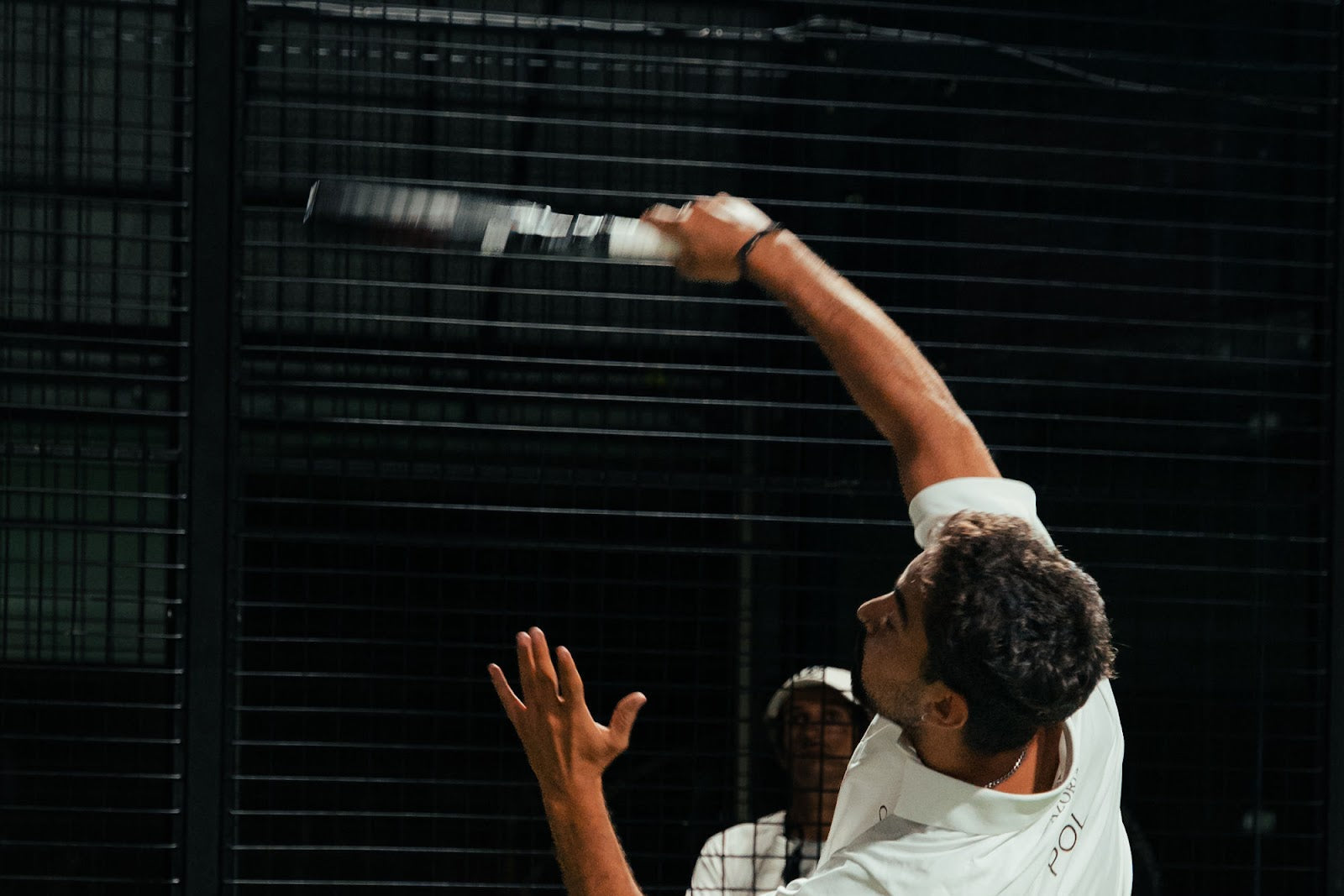
Most people come to padel for the company and leave having done a proper workout without noticing. Padel is good exercise: an hour of social doubles burns somewhere between 500 and 800 calories and holds the heart at 70 to 80 percent of its maximum, which is squarely in the range that builds cardiovascular fitness. The catch, and the appeal, is that it never feels like training.
The short version: Yes. A one-hour padel match is a genuine workout: roughly 500 to 800 calories, a heart rate of 140 to 160 beats per minute, and full-body movement that trains the legs, core, shoulders and reflexes at once. It does the work of a vigorous run with less pounding and far more conversation.
Is padel a good workout, or just a good time?
Both, which is the whole point. A padel match keeps you at around 70 to 80 percent of your maximum heart rate for most of the hour, with players burning an estimated 500 to 800 calories depending on weight, level and how hard the rallies run. Beginners, who stand still more and chase less, sit nearer 300 to 400. The number climbs with skill, because better players move more, not less.
What makes those figures honest rather than marketing is the shape of the effort. Padel is interval work disguised as a game. You sprint two steps, brake, twist, reach, then walk back to the line and breathe. Stop, start, stop, start, for an hour. The body reads that as high-intensity intervals, the format most coaches would prescribe deliberately, except here you are chasing a ball off the back glass instead of watching a clock.
The science backs the felt experience. A 2022 review of padel and physical fitness concluded that regular play is recommended to improve fitness and promote health in adults and children alike, and studies of match play put the average heart rate around 75 percent of maximum. You are training. You are simply too busy arguing about whose ball that was to register it.
What does padel actually train?
It trains more of the body than almost any single gym machine, because the court asks for everything at once. In one rally you accelerate, decelerate, rotate through the hips, reach overhead and recover balance, all while reading two opponents and a partner.
The legs and the engine
The lower body does the heavy lifting. Padel is a sport of short sprints, lunges and hard stops, so the quads, glutes, calves and hamstrings work constantly, and the change-of-direction loading builds the kind of leg strength that running alone never touches. The heart and lungs get the cardiovascular session described above: enough sustained intensity to improve aerobic capacity over a season of regular play.

The core, shoulders and the brain
Every shot is driven from the trunk, so the core and obliques are engaged on each swing, and the rotation is what spares the joints the repetitive pounding of distance running. The shoulders, forearms and wrists handle the racket. Then there is the part no treadmill offers: padel is a thinking sport. The stop-start pattern and constant decision-making sharpen reflexes and coordination, and research links racket sports of this kind to better balance, mood and even brain health. You leave the court tired in the legs and oddly clear in the head.

How does padel compare to other workouts?
For most amateur players, an hour of padel sits close to a vigorous run or a spin class for calorie burn, but lands far more gently on the knees, hips and back. The table below is a fair, rounded comparison for a recreational hour.
| Activity (1 hour) | Approx. calories | Joint impact | Sociable |
|---|---|---|---|
| Padel (social doubles) | 500 to 800 | Moderate | High |
| Steady jogging | 500 to 700 | High | Low |
| Cycling (moderate) | 450 to 650 | Low | Medium |
| Reformer Pilates | 250 to 400 | Low | Low |
| Brisk walking | 250 to 350 | Low | Medium |
Two things matter more than the exact numbers. First, the best exercise is the one you keep doing, and padel is dangerously easy to keep doing, because it is a standing date with friends rather than a chore. Second, the joint impact column is why padel suits players in their forties and fifties who have retired their knees from running but have no intention of slowing down.
So is padel enough on its own?
Almost, but not quite. Padel gives you cardiovascular fitness, agility, coordination and a good deal of leg and core strength. What it does not do is build maximal strength or correct the small imbalances that come from playing one-handed, twisting mostly one way, week after week.
The players who last, and who keep improving past the first plateau, treat padel as the centre of a wider routine. A little strength work for the legs and shoulders. Mobility for the hips and thoracic spine. Sensible recovery after the longer sessions. That is the quiet argument the house has always made: movement is a rhythm, not a single event. The court is where it is most fun. It is not the only place it happens.

Padel, at Azoria
At Azoria, padel sits at the centre of the day rather than at the end of it. The Azoria Padel Club runs courts for members and their guests, with coaching by appointment through the Azoria Padel Academy for anyone who wants to play more, and better. The fitness it gives you is real, and we treat it that way.
For the parts padel does not cover, the Azoria Fitness Club handles strength and mobility, and the house's approach to recovery closes the loop after a long match. New to the game? Start with our guide to padel for beginners in Uluwatu, then read what to do in the hours after you come off court. The point is never the calorie count. The point is a body that works well for a long time, kept that way by something you actually look forward to.
Frequently asked questions
Is padel good exercise for weight loss?
Yes. At 500 to 800 calories an hour and a heart rate of 70 to 80 percent of maximum, padel burns at a rate comparable to a vigorous run, and the social pull makes it easy to play often enough to matter. Paired with sensible eating, it is an effective and sustainable way to manage weight.
How many calories does an hour of padel burn?
Roughly 500 to 800 for a recreational player, depending on body weight and intensity. Beginners who move less burn around 300 to 400, while faster, higher-level matches can reach 800.
Is padel better exercise than tennis?
Different, not strictly better. Padel involves more continuous, shorter movements and a smaller court, so rallies last longer and the cardiovascular load is steady. Tennis has bigger single efforts and more serving. For most amateurs, padel is easier to sustain and gentler on the joints.
Is padel a full-body workout?
Close to it. The legs and heart do the most, the core drives every shot, and the shoulders and forearms handle the racket. It also trains balance, reflexes and coordination. It does not build maximal strength, so a little gym work alongside it goes a long way.
Can padel improve fitness if I am over 50?
Yes, and it suits older players well. The low pounding compared with running spares the knees and hips, while the cardiovascular and coordination benefits are exactly the ones that protect health and independence with age. Build up gradually and warm the body before play.
The truest test of whether something is good exercise is whether you are still doing it next year. By that measure, padel quietly wins. You arrive for the company, you leave having trained, and you book the next court before you have caught your breath.
Further reading
National Geographic on why padel is a strangely effective workout for both brain and body.
A 2022 narrative review in the International Journal of Environmental Research and Public Health on padel, physical fitness and health promotion.
The International Padel Federation for the rules, the court and the global growth of the game.
Share:
Padel Americano: The Social Format, Explained
Recovery After Padel in Bali: The Hours That Matter