



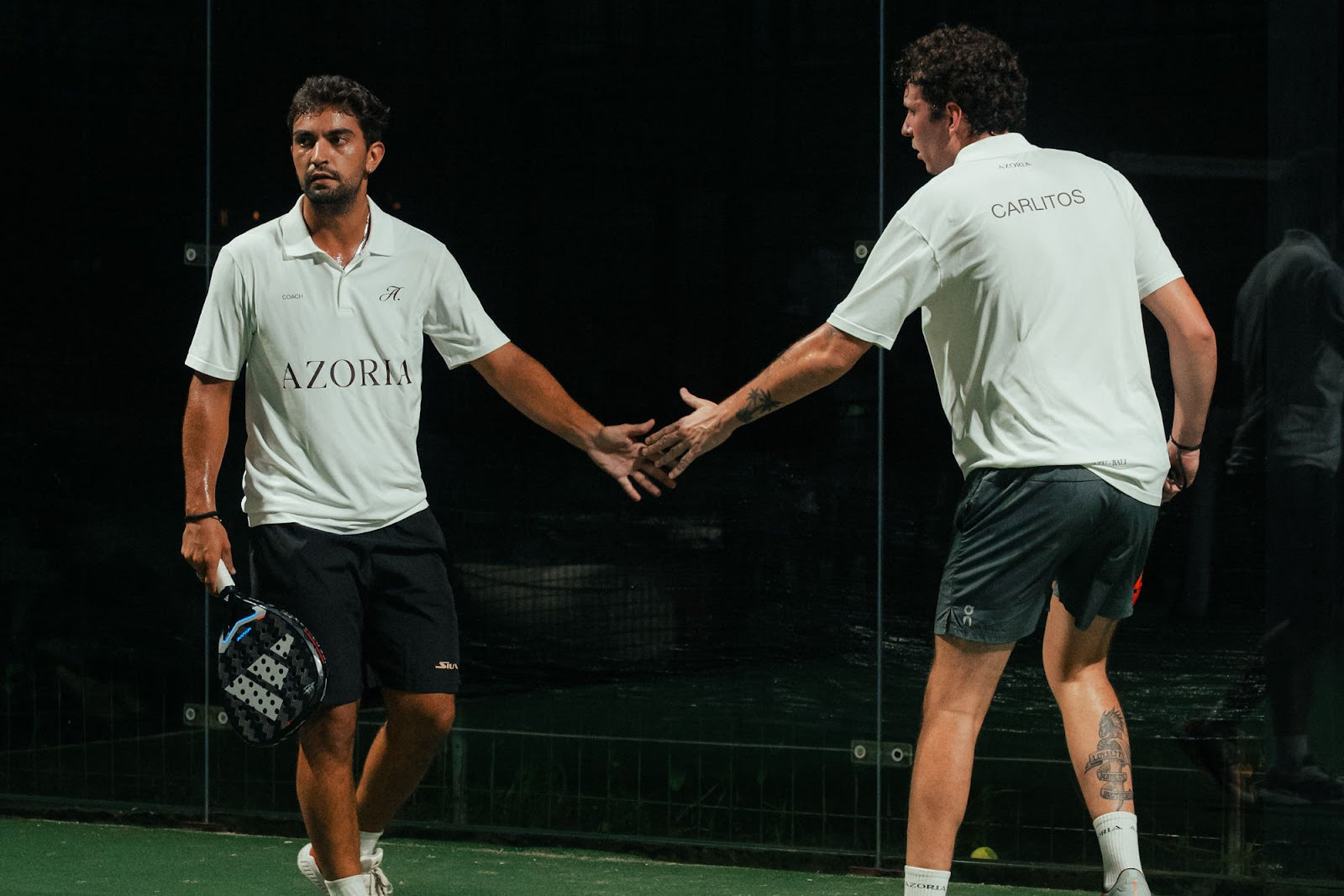
Padel rewards the player who thinks, not the player who hits hardest. The game is won a metre at a time, by standing in the right place and moving with your partner, and padel strategy is mostly the discipline of holding good position and choosing the patient shot over the spectacular one. Learn where to stand, when to come forward, and when to send the ball back over their heads, and you will beat players who strike the ball far better than you.
The short version: Win the net and keep it. Move as a pair, two players advancing and retreating together, never one up and one back. When you are pushed back, lob deep and high to reset the point and take the net again. Play down the middle, wait for the error, and let the court do the work.
What is the golden rule of padel strategy?
The team that controls the net controls the point. From the net you take the ball early, angle it down, and force your opponents to hit up to you from the back of the court. Nearly every point in padel is a quiet negotiation over who gets to stand at the net, and the pair that wins that argument usually wins the game.
This is the one idea everything else serves. You attack in order to reach the net. You lob in order to take it back. You defend in order to earn the chance to move forward again. Keep it in mind and the rest of the tactics stop being a list of tricks and start being a single, sensible plan.
Where should you stand on a padel court?
Stand level with your partner, side by side, covering a lane each. The two of you move as one unit: both at the net when you attack, both near the back glass when you defend, and never split with one player forward and one stranded behind. The distance between a well-drilled pair and a loose one is almost always this.
It helps to think of the court in three zones.
| Zone | Where | What you do there |
|---|---|---|
| The net | About 2 to 3 metres from the net | Attack. Volley down, angle the ball, finish points. |
| No man's land | Around the service line | Pass through, do not stay. The weakest place to be caught. |
| The back | 2 to 3 metres off the back glass | Defend. Use the walls, stay calm, lob to reset. |
The zone to avoid is the middle one, no man's land, around the service line. Caught there, you take the ball at your feet and hit up to opponents who are already looking down at you. Pass through it on your way forward, do not camp in it. Move as a pair, and shift together left and right with the ball to protect the middle first.

How do you win the net, and keep it?
Come forward behind a good ball, ideally a deep lob or a low, controlled shot that keeps them pinned at the back, and take the net together. Once there, you do not need heroics. Simple, controlled volleys, angled down and away, win more points than wild smashes. Keep the ball low to their feet, stay patient, and wait for the short reply.
Two details keep you there. First, do not press right up against the net, or a lob sails over you; stand roughly two to three metres back, light on your feet, ready to step in for the volley or turn for the smash. Second, when you do smash, choose control and placement over power. The out ball off the side glass, the slow bandeja that buys time, and the well-placed vibora are the shots that hold the net rather than gamble it away. If those words are new, the padel shots guide breaks them down.

When should you lob?
Lob when your opponents own the net and you are on the back foot. The lob is the most useful shot in padel: one good one, high and deep, forces the net players to turn and retreat, and hands the initiative back to you. It is not a defensive last resort, it is the main tool for taking the net away from a stronger pair.
A lob works when it clears the net players' rackets and lands deep, near the back glass, so they cannot smash it and you and your partner have time to move up. Too short and you have set up an easy smash for them. Play it with height and depth, then advance while they are busy going backwards.
How do you defend and read the glass?
When you are pushed back, both players drop to two or three metres off the back wall, each covering a half, and use the glass rather than fear it. The walls are on your side: let a hard, flat drive travel past you and play it as it comes off the back glass, instead of taking it early and cramped. A high, looping ball bounces on the floor first, then off the glass at a steep angle and sits up shorter, toward the middle, so adjust your feet for it.
From defence, the plan is simple. Stay calm, keep the ball in play, hit low and slow to their feet or throw up a deep lob, and wait for the moment to move forward. Good defending is not desperate, it is patient. Reset the point, then climb back to the net. Recovery matters too, since a long match is a lot of these retreats and sprints, and there is a note on that in recovery after padel.

Play the percentages
Two habits win matches without a single highlight. Hit down the middle, between the two opponents: it kills their angles, invites a moment of "yours or mine," and takes the sideline error out of your own game. And when in doubt, direct the ball at the weaker player or at the feet of whoever is at the net. Consistency beats brilliance in padel more than in almost any other racquet sport, because the walls keep the ball alive and the player who misses first usually loses.
The thinking game
Padel is a European racquet sport built for conversation, and its tactics reward the same things the house does: patience, position, and playing well with the person next to you. At the Azoria Padel Club in Uluwatu, the game is meant to be learned properly, not just picked up. A morning with a coach at the Azoria Padel Academy will teach your feet where to stand faster than a season of guessing, and our coaches spend as much time on position and pairing as on the swing. Learn the shape of the point, and the rest of the match gets quieter and better.
New to the game? Start with padel for beginners and the rules, then find where to play padel in Uluwatu. And when you want the social version, the Americano format is the friendliest way to put all of this into practice.
Frequently asked questions
What is the most important rule in padel strategy?
Win and hold the net. The pair standing at the net takes the ball early and hits down, while the pair at the back has to hit up. Almost every tactic in padel exists to help you reach the net or take it back.
Where should beginners stand on a padel court?
Side by side with your partner, a lane each, and move together. Both of you come forward to attack and both drop back to defend. The worst position is one player up and one player back, which leaves a gap through the middle.
When should you lob in padel?
Lob when your opponents hold the net and you are under pressure. A high, deep lob forces them to retreat and lets you and your partner move forward, so it is your best tool for taking the net away from a stronger pair.
Should you hit down the middle in padel?
Often, yes. A ball through the middle removes your opponents' angles and creates a moment of hesitation over who should take it. It is also safer than aiming for the lines, where the error is yours.
How do you defend against a smash in padel?
Both players stand two to three metres off the back glass, stay calm, and let the ball rebound off the wall rather than crowding it. Keep it in play with a low reply or a deep lob, reset the point, and look to move forward again.
The best players on the Bukit are rarely the ones who hit hardest. They are the ones already standing where the ball is about to be.
Further reading
- International Padel Federation, the sport's governing body and the source for its official rules.
- The Padel School, a well-regarded coaching resource for positioning, tactics and technique.
- Padel (sport) on Wikipedia, a concise overview of the game, its history and its format.
Share:
Mobility for Surfers: Training Around the Swell
Mediterranean Dining in Uluwatu: A Guide to the Table